10 Min Read
Renjith Chembakarayil

As customer engagement continues to evolve, organizations are rethinking how their contact centers are built, managed and scaled.
For SMEs and large enterprises across the MENA region, Contact Center as a Service (CCaaS) represents a shift away from rigid infrastructure and complex deployments toward flexible, cloud-driven customer experience platforms. It enables businesses to deploy, scale and manage contact center operations with greater speed, efficiency and intelligence.
This article explains what CCaaS is, how it works, why organizations are adopting it, and how it differs from traditional contact center models.
Contact Center as a Service (CCaaS)
Contact Center as a Service (CCaaS) is a cloud-based delivery model where contact center software, infrastructure and capabilities are provided as a subscription service over the internet.
Instead of purchasing, hosting and maintaining physical hardware or on-premises systems, organizations access contact center functionalities through a secure cloud platform.
In simple terms, CCaaS allows businesses to run their entire contact center from the cloud, without managing servers, telephony infrastructure or complex upgrades.
A CCaaS platform typically includes:
Voice and telephony services
Omnichannel communication (WhatsApp, email, chat, video, social messaging)
Intelligent routing and queue management
Agent desktops and supervisor tools
Analytics, reporting and dashboards
AI-powered automation and insights
CRM and business system integrations
CCaaS transforms the contact center from a fixed operational setup into a flexible, scalable and intelligent service.
Why CCaaS Emerged?
Contact Center as a Service (CCaaS) emerged as organizations sought greater flexibility, faster deployment and easier scalability in customer engagement operations.
Traditionally, many enterprises relied on on-premises contact centers, where systems were hosted within their own infrastructure. This model continues to be relevant for organizations that require high levels of control, data residency, customization or regulatory compliance.
However, as customer expectations evolved and digital channels expanded, many businesses began looking for deployment models that could:
Support rapid growth and change
Enable remote and distributed teams
Reduce infrastructure management overhead
Introduce new channels and AI capabilities faster
CCaaS was introduced to meet these needs by offering a cloud-based contact center deployment model, while still allowing enterprises to choose the architecture that best fits their operational, security and compliance requirements.
Today, both CCaaS and on-premises contact centers coexist, each serving different business scenarios.
CCaaS vs On-premises Contact Centers
Aspect | On-premises Contact Center | CCaaS (Cloud Contact Center) |
|---|---|---|
Deployment | Installed within organization infrastructure | Delivered via the cloud |
Control | Full control over systems and data | Managed infrastructure with configurable controls |
Scalability | Planned and capacity-based | On-demand and elastic |
Compliance | Ideal for strict regulatory environments | Supports compliance with cloud governance |
Customization | Deep customization is possible | Configuration-driven flexibility |
Remote work | Requires additional setup | Built-in support |
Upgrade cycles | Scheduled and managed internally | Continuous updates by provider |
Best suited for | Government, BFSI, Regulated companies | Growing enterprises, Distributed teams, Digital-first businesses |
CCaaS, On-premises and Hybrid Contact Centers
Many enterprises today adopt a hybrid contact center approach, combining the strengths of both CCaaS and on-premises deployments.
In a hybrid model:
Core systems or sensitive data may remain on-premises
Digital channels, analytics or AI capabilities may run in the cloud
Organizations gain flexibility without compromising governance
Hybrid contact centers are especially common in the MENA region, where regulatory requirements, data residency policies and digital transformation goals often coexist.
Supporting multiple deployment models ensures that contact center platforms can adapt as business needs evolve.
How Does CCaaS Work?
In a CCaaS model, the service provider hosts the contact center platform in the cloud. Organizations access the platform through web browsers or lightweight applications.
Core Components of a CCaaS Platform
Cloud Infrastructure
The entire system runs on secure cloud environments, ensuring high availability, redundancy and performance.Subscription-based Access
Organizations pay a recurring fee based on usage, number of agents or features required.Browser-based Agent Experience
Agents can log in from anywhere, making CCaaS ideal for remote, hybrid or distributed teams.Centralized Management
Administrators configure workflows, routing rules, SLAs and reports through a unified dashboard.Continuous Updates
New features, security patches and AI capabilities are rolled out automatically without downtime.
This architecture allows businesses to focus on customer experience and outcomes, rather than infrastructure management.
Key Capabilities of a Modern CCaaS Platform
A CCaaS platform is more than a cloud-hosted call system. It combines communication, intelligence and analytics into a single experience layer.
Omnichannel Engagement by Default
CCaaS platforms are designed to support multiple channels from day one:
Voice calls
WhatsApp and messaging apps
Email
Live chat
Video interactions
All interactions are unified into a single customer journey, allowing agents to switch channels without losing context.
Intelligent Routing and Automation
CCaaS platforms use rules and AI-driven logic to route interactions effectively.
Routing can be based on:
Customer intent
Language preference
Agent skills
Priority or customer tier
Channel type
Automation reduces manual effort, shortens wait times and improves first-contact resolution.
Unified Agent Desktop
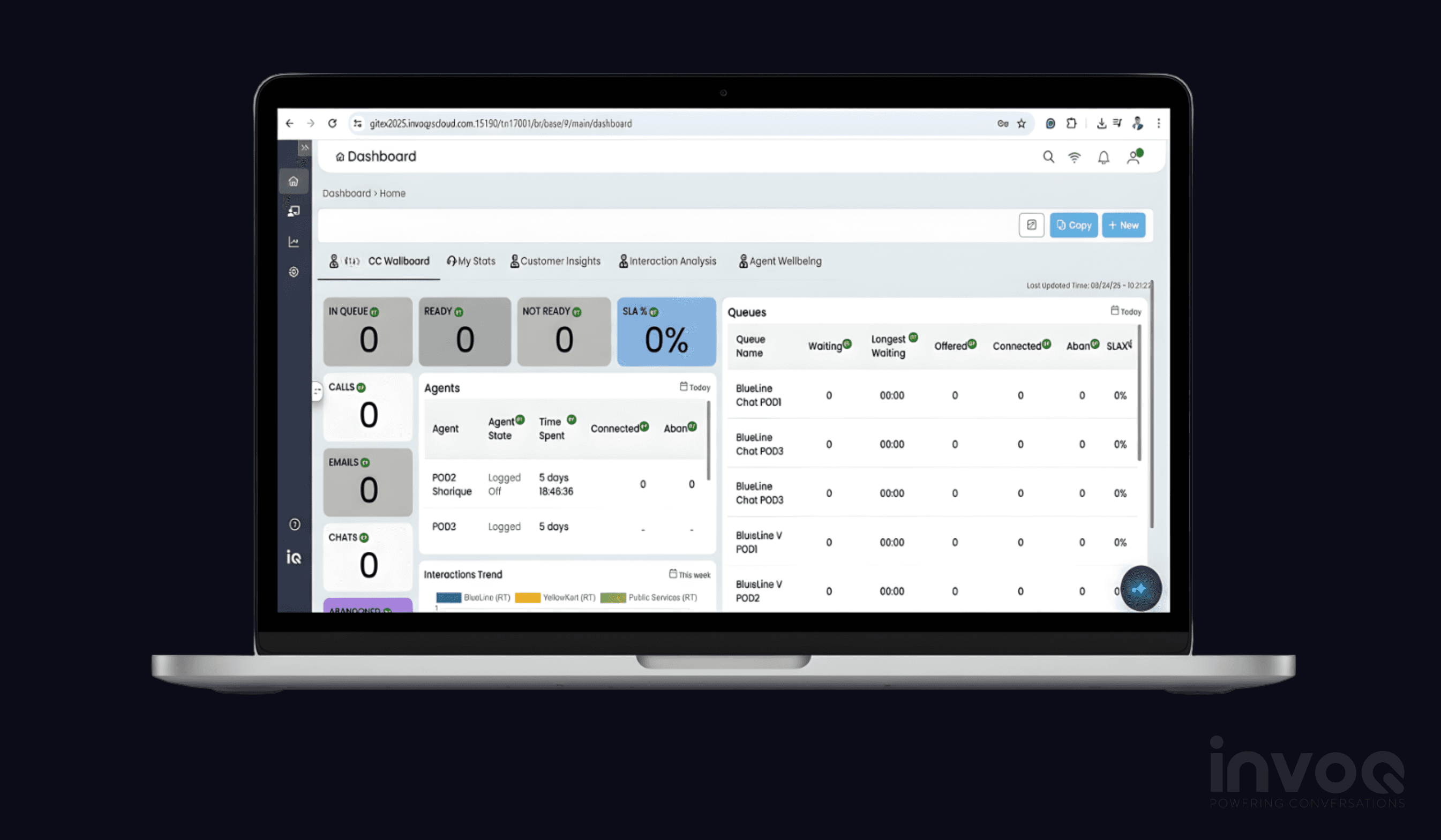
Agents work from a single interface that brings together:
All active and past conversations
Customer profiles and CRM data
Knowledge base and scripts
AI-powered suggestions and summaries
This unified view improves productivity and ensures consistent service quality.
Platforms like INVOQ follow this approach by consolidating voice, WhatsApp, email, chat and video interactions into one intelligent CX interface.
Built-in Analytics and Reporting
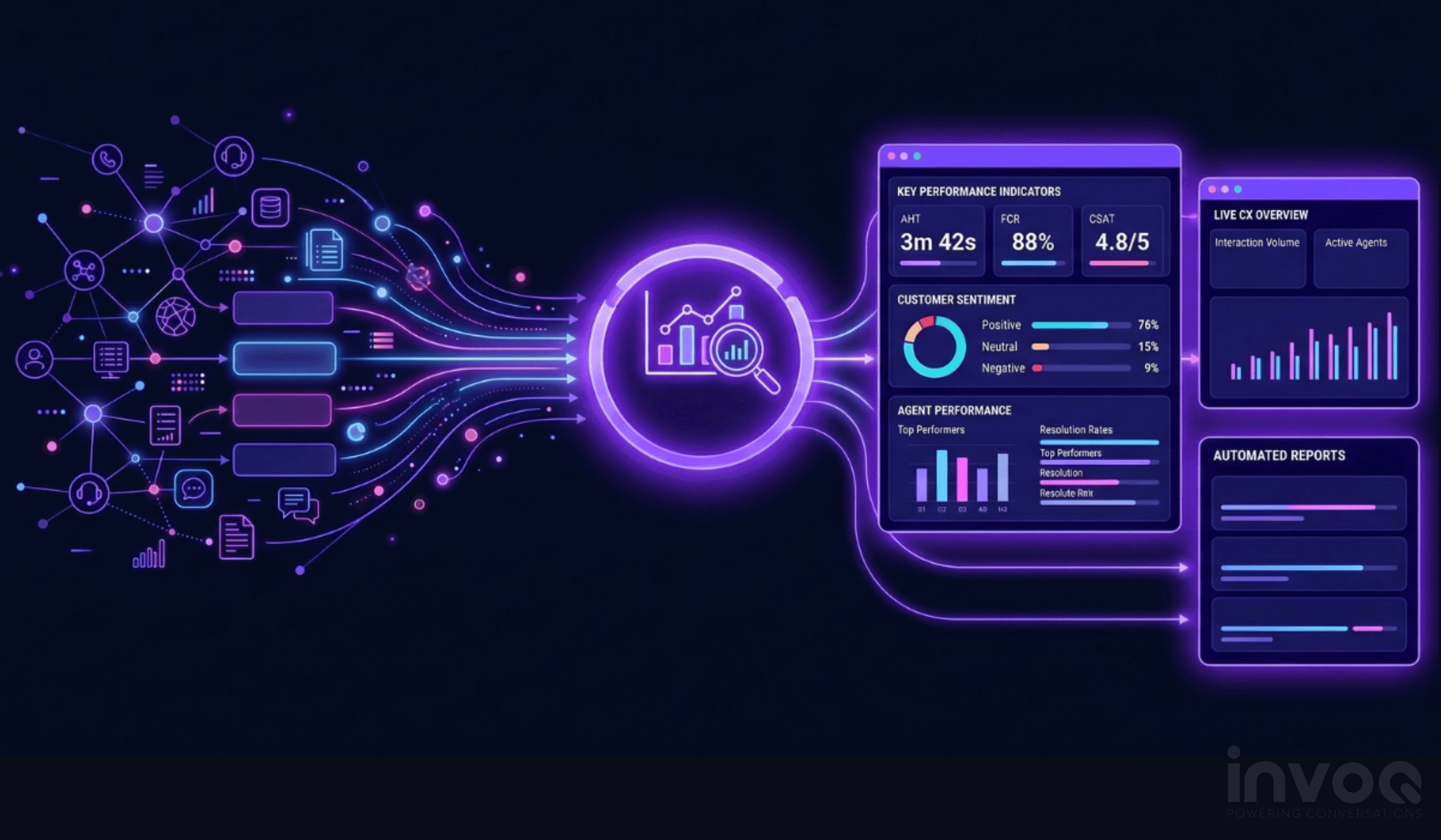
CCaaS platforms provide real-time and historical insights into contact center performance.
Common metrics include:
Interaction volumes by channel
Average handling time
First-contact resolution
SLA adherence
Customer satisfaction trends
Agent productivity
Advanced analytics help organizations move from reactive operations to proactive decision-making.
AI-powered Capabilities
Modern CCaaS platforms increasingly embed AI across the contact center lifecycle.
Examples include:
Conversational IVR and virtual agents
Real-time agent assistance
Speech-to-text transcription
Sentiment and intent analysis
Automated call summaries
AI-based quality scoring
AI enables contact centers to scale service quality without proportionally increasing headcount.
Benefits of CCaaS for Enterprises
Faster Deployment and Time to Value
CCaaS platforms can be deployed in weeks rather than months. Organizations can quickly launch new teams, campaigns or service lines without infrastructure delays.
Scalability Without Complexity
CCaaS allows businesses to scale agents, channels and capacity based on demand.
This is especially useful for:
Seasonal spikes
Campaign-driven operations
Government helplines
Crisis or emergency response
Capacity can be adjusted without major technical changes.
Support for Remote and Hybrid Teams
Agents can work securely from any location with an internet connection. This expands talent access, reduces facility costs and supports business continuity.
Predictable Costs
The subscription-based pricing model converts large upfront investments into manageable operating expenses. Organizations pay for what they use, improving financial planning.
Continuous Innovation
Because CCaaS platforms are cloud-native, new features, security enhancements and AI capabilities are introduced continuously without disruption.
CCaaS Use Cases Across Industries
Banking and Financial Services
Customer onboarding
Account support and inquiries
Fraud alerts and verification
Compliance-driven monitoring
CCaaS enables secure, scalable and monitored customer engagement.
Government and Public Services
Citizen service desks
Appointment scheduling
Multilingual support
SLA-driven response tracking
Cloud-based contact centers improve transparency and service accessibility.
Outsourcing and BPOs
Multi-client operations
Rapid agent onboarding
Campaign-based scaling
Client-level reporting
CCaaS provides flexibility and cost efficiency
Sales and Lead Generation
Outbound dialing campaigns
Omnichannel follow-ups
CRM-integrated workflows
Conversion analytics
Sales teams benefit from faster outreach and better visibility.
Customer Support Teams
Issue resolution
Complaint handling
Retention and loyalty programs
Post-service engagement
Unified interactions lead to higher satisfaction and consistency.
Why CCaaS Matters in the MENA Region?
The MENA region presents unique customer engagement requirements that align strongly with CCaaS model.
High Adoption of Messaging Channels
WhatsApp is a primary communication channel for customers across the region. CCaaS platforms integrate messaging seamlessly with voice and email, ensuring unified experiences.
Multilingual Customer Expectations
Enterprises serve diverse populations requiring Arabic, English and other language support. CCaaS enables language-based routing and skill matching.
Government-led Digital Transformation
Public sector organizations are modernizing citizen services. Cloud-based contact centers support scalable, transparent and connected service delivery.
Rapid Business Growth and Change
Enterprises in the GCC region often scale quickly. CCaaS supports growth without operational bottlenecks.
Compliance and Security Needs
Modern CCaaS platforms support:
Role-based access
Secure data handling
Audit trails and recordings
SLA monitoring
This balances innovation with regulatory requirements.
CCaaS and Future of Contact Centers
CCaaS is not just a deployment model; it is the foundation for the future of customer experience.
As AI, analytics and automation continue to mature, CCaaS platforms will increasingly:
Predict customer needs
Guide agents in real time
Automate routine interactions
Turn conversations into business insights
The contact center will continue its transformation from a support function into a strategic experience and intelligence hub.
Choosing the Right Contact Center Model
Contact Center as a Service (CCaaS) represents an important evolution in how organizations design and operate customer engagement platforms. By delivering contact center capabilities through the cloud, CCaaS enables flexibility, scalability and faster access to modern technologies such as AI, analytics and omnichannel communication.
At the same time, on premises contact centers continue to play a vital role for enterprises that require higher levels of control, customization and regulatory alignment. For many organizations, a hybrid approach offers the best balance between innovation and governance. The key is not choosing one model over another but selecting a platform that supports multiple deployment options and can evolve with business requirements.
INVOQ is built with this flexibility in mind. It supports CCaaS, on-premises and hybrid contact center deployments, enabling organizations across the MENA region to modernize customer engagement at their own pace. By unifying voice, WhatsApp, email, chat and video into a single intelligent CX platform, INVOQ helps enterprises connect conversations with outcomes; clearly, securely and efficiently.
As customer expectations continue to rise, the future of contact centers will be defined not by infrastructure alone, but by how effectively organizations deliver connected, intelligent and meaningful experiences across every interaction.
Contact us to see how INVOQ can give an
effortless experience for your customers